Mauryan Empire · Chandragupta Maurya · Ashoka · Dhamma
Understanding the difference between a kingdom and an empire
A kingdom is a territory ruled by a king. It is usually a single region with one ruler and one language or culture. A empireA large territory made up of many different regions, peoples, and cultures, all controlled by one powerful ruler called an Emperor (Samrat). is much bigger — it is made up of many different kingdoms, regions, and peoples, all brought under the control of one powerful ruler.
| Feature | Kingdom | Empire |
|---|---|---|
| Size | Smaller, single region | Very large, spans many regions |
| Ruler's Title | Raja (King) | Samrat (Emperor) |
| Diversity | Usually one culture/language | Many cultures, languages, peoples |
| Administration | Simple, direct rule | Complex, layered administration |
| Example | Magadha kingdom | Mauryan Empire |
6th to 4th century BCE — how one kingdom set the stage for India's first empire
The period between the 6th and 4th century BCE was one of profound change in north India. Much of north and central India was divided into sixteen large kingdoms called MahājanapadasMahājanapadas means "great kingdoms" or "great realms." These were large, well-organized states in the Gangetic plains with their own assembly systems. (Mahā = great, Jana = people, Pada = land).
One of these kingdoms, Magadha (in modern-day south Bihar and some adjoining areas), rose in importance and set the stage for the fusion of many kingdoms into India's first empire. Powerful early kings, such as Ajātaśhatru, played a crucial role in establishing Magadha as a dominant centre of power.
Magadha was located in the resource-rich Ganga plains, which gave it many natural advantages:
| Resource | Advantage |
|---|---|
| Fertile land | Grew large amounts of food to feed the population and army |
| Abundant forests | Timber for building; elephants for warfare |
| Iron ore | From nearby hilly regions — crucial for expansion |
| Ganga & Son rivers | Geographic advantage for trade and transportation |
The use of iron transformed technologies such as agriculture and warfare. Iron ore and minerals from the nearby hilly regions proved crucial:
Around the 5th century BCE, Mahāpadma Nanda rose to prominence in Magadha and founded the Nanda dynasty. He:
The last Nanda emperor, Dhana Nanda, though very rich, became highly unpopular — he oppressed and exploited his people. This paved the way for the Nanda empire to be conquered and absorbed into what would become one of the largest empires India ever knew — the Maurya empire.
Chanakya (also known as Kautilya or Vishnugupta) was a brilliant scholar, teacher, and strategist who wrote the famous ArthashastraThe Arthashastra is an ancient Indian treatise on statecraft, economic policy, and military strategy written by Chanakya. It covers administration, taxation, diplomacy, war, and governance in extraordinary detail.. He found a young, talented boy named Chandragupta and trained him to become a ruler — ultimately overthrowing the Nanda dynasty.
Alexander the Great reaches northwest India — 326 BCE
While events unfolded in Magadha in the east, the northwestern region of the subcontinent was home to smaller kingdoms along an ancient route connecting to the Mediterranean. Among them were the Pauravas, led by their king Porus.
Alexander, a young and powerful king from Macedonia (Greece), campaigned against the Persian Empire (334–331 BCE) to avenge earlier Persian invasions of Greece. He conquered the Persian Empire and spread Greek culture — his empire now covered three continents, one of the largest in world history.
Eager to reach the "end of the world", Alexander pushed further east and brought his campaign to India. He defeated Porus in Punjab. Greek records mention:
Tired and homesick, Alexander's soldiers lost the will to fight and refused to move deeper into India towards the Ganga river. Alexander and part of his army retreated to Persia — but through the coastal route in the south and Iran's harsh desert, resulting in heavy losses from thirst, hunger, and disease.
Back in Persia, Alexander faced rebellions and political turmoil. He fell ill and died in Babylon at the age of 32. His immense empire was soon divided between his generals and satraps, who created their own kingdoms.
Alexander heard of Indian sages called Gymnosophists (Greek for "naked philosophers" — they wore very little clothing) who were renowned for their wisdom. He challenged them with tricky riddles, warning he would put those who gave wrong answers to death. The Gymnosophists responded calmly and intelligently. Alexander was impressed and spared them all.
| Alexander's Question | Gymnosophist's Answer |
|---|---|
| "Which is stronger — life or death?" | "Life, because it endures while death does not." |
| "How can a man be most loved?" | "If he is most powerful and yet does not inspire fear." |
Historians view this as a meeting of two great traditions — Greek and Indian philosophies.
The founder of India's first great empire
How Chandragupta Built an Empire...
A young boy, a brilliant teacher, and a dream to unite India...
Chanakya spotted Chandragupta playing as a "king" with village boys and saw potential.
He handed the throne to his son Bindusara, became a Jain monk, and walked south to Sravanabelagola, Karnataka, where he fasted to death (sallekhana) — the highest Jain virtue.
Kauṭilya (also called Chanakya or Viṣhnugupta) was a teacher at the world-renowned Takṣhaśhila university in northwest India. He went to the court of Dhana Nanda (the last Nanda king) and advised him to change his ways. Dhana Nanda — proud and powerful — insulted Kauṭilya and threw him out of the court.
This proved to be Dhana Nanda's greatest mistake. An angry Kauṭilya vowed to destroy Nanda rule and found a talented young man named Chandragupta to train and prepare for overthrowing the empire.
Kauṭilya's most famous work is the Arthaśhāstra — which means "the science of governance and economics." It listed directives in many areas including economics, administration, justice, urban planning, agriculture, and people's welfare. Kauṭilya had a clear vision of how a kingdom (rājya) should be established, managed, and consolidated.
One of his most important political concepts is the Saptāṅga ("seven limbs/parts") — the seven parts that together constitute a kingdom. According to Kauṭilya, the saptāṅga together must create a settled, well-protected, and prosperous kingdom, to be maintained both through warfare and through alliances for peace, as the situation demands.
Kauṭilya emphasized the importance of law and order in society, which needed a strong administration. He also detailed many laws to deal with corruption and specified punishments for activities that went against the wellbeing of the people.
Just a few years after Alexander left India, Chandragupta Maurya founded the Mauryan Empire in 321 BCE. He quickly absorbed the Nanda territories and went on to expand his control even further:
The Greek king Seleucus Nicator (one of Alexander's generals) was eventually defeated by Chandragupta. Peace was made, and Seleucus sent a Greek historian and diplomat named Megasthenes to Chandragupta's court at Pāṭaliputra.
Megasthenes stayed for many years and wrote a book called Indika — the first written account of his travels in India by a foreigner. Unfortunately, the original Indika is mostly lost; only excerpts quoted by later Greek scholars survive. It remains one of the most important sources about Mauryan India.
The greatest empire ancient India had ever seen
Mauryan Empire c. 250 BCE (traditional depiction) — covered ~5 million km², larger than modern India! | Source: Wikimedia Commons
The Mauryan Empire — key events from 321 BCE to 232 BCE
The emperor who changed from a conqueror to a messenger of peace
Ashoka (also spelled Aśoka) was the third emperor of the Mauryan dynasty. He was born around 304 BCE and became emperor around 268 BCE. His full title was Devanampiya Piyadasi — "Devanampiya" means "Beloved of the Gods" and "Piyadasi" means "one who regards others with kindness."
Ashoka is considered one of the greatest rulers in world history. He is remarkable not just because he was a powerful emperor, but because he voluntarily gave up conquest, adopted non-violence, and spent his life working for the welfare of his people and all living beings.
Ashoka (268–232 BCE) was the grandson of Chandragupta Maurya — his father was Bindusara. He came to be credited with major administrative and religious achievements.
At the beginning of his reign, Ashoka was quite ambitious. He inherited a vast empire but further expanded it to cover almost the entirety of the Indian subcontinent — except for the southernmost region — including present-day Bangladesh, Pakistan, and parts of present-day Afghanistan.
One encounter, however, is said to have changed the path of his life — the ferocious war he waged against Kalinga (modern-day Odisha). Seeing the enormous death and destruction, Ashoka chose to give up violence and adopted the path of peace and non-violence that the Buddha taught.
The war that changed an emperor's heart forever
Ashoka's massive Mauryan army prepares to march on Kalinga (modern Odisha). War drums (Bherighosha) echo across the land. Kalinga refuses to submit — they will fight for their freedom.
One of the bloodiest battles in ancient Indian history. The Kalinga warriors fought bravely but were overwhelmed by Ashoka's far larger army. The Daya River near Bhubaneshwar ran red with blood.
Surveying the devastation — 100,000 dead, 150,000 prisoners, countless more displaced — Ashoka was overwhelmed with remorse and grief. He converted to Buddhism and vowed never to fight a war of conquest again.
The devastation of Kalinga led to one of history's most remarkable transformations. Ashoka wrote about his grief in his own edictsEdicts are official orders or proclamations inscribed (carved) on rocks, pillars, or cave walls by a ruler. Ashoka had his messages, laws, and principles carved across his empire for all to read.:
"All the people who were killed, died or were carried away captive in the Kalinga country weigh heavily on the mind of the Beloved of the Gods."
Ashoka replaced Bherighosha (war drums — announcing military campaigns) with Dhammaghosha (announcements of the Dhamma — moral teachings). He gave up hunting, reduced the killing of animals, and devoted himself to the welfare of his subjects.
Embracing Buddhist teachings after the Kalinga war, Ashoka sent emissaries to Sri Lanka, Thailand, Central Asia, and beyond to spread the message of the Buddha far and wide.
A universal code of ethics — not just a religion, but a way of life
DhammaDhamma (Sanskrit: Dharma) in Ashoka's context means a code of moral conduct based on non-violence, truth, respect for all, and compassion. It was not just Buddhism but a universal ethical code for all people regardless of religion. was Ashoka's code of moral conduct. It was NOT simply Buddhism — it was a set of universal ethical principles drawn from Buddhist thought but meant for people of all religions and walks of life.
Think of Dhamma as Ashoka's attempt to create a shared moral foundation for his diverse empire — a set of values that a Hindu, Buddhist, Jain, or anyone else could follow.
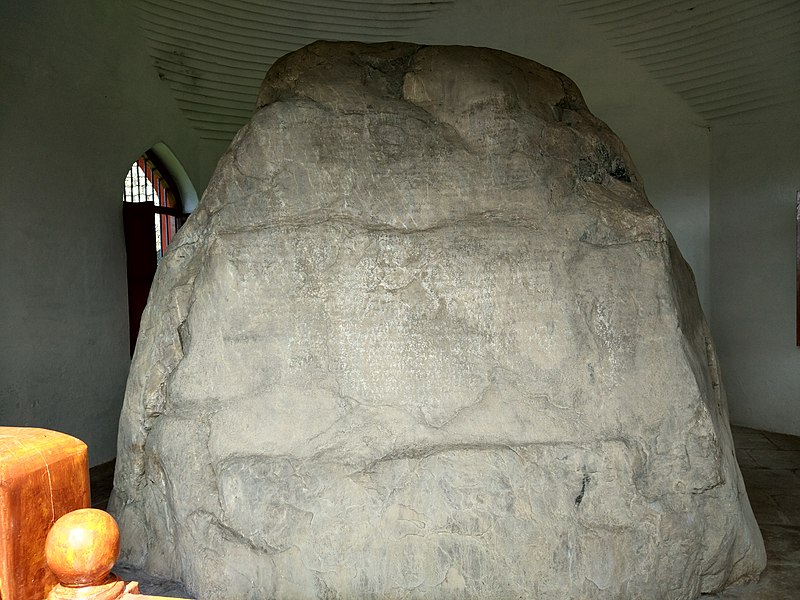
Ashoka had his messages, laws, and principles carved on rocks and pillars across the entire empire — from Afghanistan to South India to Nepal. These are called edicts.
Carved on large natural boulders and rock surfaces. 14 Major Rock Edicts found at various locations. Cover Dhamma principles, welfare measures, and messages of peace.
Carved on tall, polished stone pillars erected by Ashoka. 7 Pillar Edicts found at places like Delhi, Allahabad, Vaishali. The famous Sarnath pillar has the Lion Capital.
Most edicts were inscribed in Prakrit — the popular language spoken across many parts of India — and written in the Brahmi script. Some northwestern edicts used Kharosthi; those near the Greek/Persian border used Greek and Aramaic. Brahmi is considered the mother of all regional scripts of India.
Ashoka sent Buddhist missionaries across Asia. His son Mahinda went to Sri Lanka. His daughter Sanghamitra also went to Sri Lanka with a branch of the Bodhi tree!
Source: Wikimedia Commons
The language of Ashoka's edicts shows he was deeply interested in depicting himself as a benevolent and compassionate ruler. He took remarkable steps for the welfare of his people and all living beings:
How Ashoka governed the largest empire in ancient India
The Mauryan Empire needed a sophisticated system to govern such a vast territory. Here is the administrative hierarchy:
The empire was divided into 4 major provinces (KumaraKumara means "prince" in Sanskrit. In the Mauryan system, each major province was governed by a Kumara — a prince of the royal family, usually a son of the emperor — who had viceregal powers. provinces), each governed by a royal prince:
Cities like Pāṭaliputra were bustling centres of governance and commerce. They had palaces, public buildings, and well-planned streets. With a well-organised taxation system and brisk trade, the treasury remained strong — fuelling the empire's growth and prosperity. Officials, merchants, and artisans all played key roles in city life.
The Greek ambassador Megasthenes' account gives us a vivid picture of Mauryan society:
How economic power built and sustained the Mauryan Empire
Maintaining an army is very costly — soldiers need food, clothing, weapons, and pay; elephants and horses need care; roads and ships need to be built. All this requires enormous economic power.
Therefore, production and trade were key to maintaining an empire. A ruler who controlled trade routes could collect more taxes, fund his army, and ensure the welfare of his people.
Both literary sources and archaeological excavations give us evidence of what was traded:
| Category | Items Traded |
|---|---|
| Textiles | Cotton and silk cloth — exported across Asia and to Rome |
| Spices | Pepper, cardamom, turmeric — highly valued in foreign markets |
| Agricultural Produce | Grain, rice, sugar, oil |
| Luxury Items | Gems, ivory, handicrafts, precious metals |
| Animals | Elephants, peacocks, exotic birds |
Indian goods travelled to distant countries by both land routes and sea routes.
Traders soon understood the benefit of joining together and forming guilds (Shrenīs). A guild was a powerful association of traders, craftsmen, moneylenders, or agriculturists.
| Feature | Details |
|---|---|
| Who formed guilds? | Traders, craftsmen, moneylenders, agriculturists |
| Leadership | An elected head + executive officers with ethical qualities |
| Purpose | Share resources, market information, workforce — for everyone's benefit |
| Autonomy | Had the right to make their own internal rules — the king did not interfere |
| Spread | Spread across large parts of India and lasted for centuries |
How Ashoka's empire shaped India and the world forever
Ashoka's missionaries spread Buddhism to Sri Lanka, Myanmar, Thailand, China, Japan, and Central Asia. Today Buddhism has over 500 million followers worldwide.
Source: Wikimedia Commons
The stupa is a dome-shaped structure built by Ashoka across his empire to mark sacred Buddhist sites or house holy relics. The big, round hemispherical structure at the centre is called the aṇḍa.
Throughout history there have been many mighty empires — the Roman, Persian, Ottoman, Spanish, Russian, and British empires, among others. All of them are long gone. Historians keep debating the causes of their decline. The Mauryan Empire was no different.
The NCERT lists several reasons why empires fall:
Empires are, therefore, something of a paradox — they have both benefits and serious drawbacks:
| Advantages | Disadvantages |
|---|---|
| Brought political unity (Mauryan Empire unified almost the entire subcontinent) | Almost always established through war |
| Reduced or eliminated warfare among smaller kingdoms | Maintained through force and repression |
| A well-managed empire could bring greater prosperity than smaller warring kingdoms | This makes them fragile at their core and unstable over time |
The Mauryan Empire continued for about half a century after Ashoka's death (232 BCE). However, his successors were unable to hold the vast empire together. One by one, the smaller kingdoms that had been under Mauryan control broke off and became independent.
Around 185 BCE, the last Mauryan king was overthrown, and India started on another phase of her history — new kingdoms, new rulers, and new challenges ahead.
Click one item from Column A, then one from Column B to match them!